ISO 17025 UKAS accredited
Over three decades of experience
Sulphide Stress Corrosion Cracking
Description
A form of hydrogen embrittlement, sulphide stress corrosion cracking (SSCC) is similar to stress corrosion cracking (SCC), however, it is a cathodic cracking mechanism, compared to the anodic reaction of SCC. In the presence of H2S, steels react to form metal sulphides and hydrogen. The hydrogen can diffuse into the metal causing embrittlement and cracking, particularly when the metal is subjected to high stress.
Mechanism
A susceptible metal, and commonly steel, reacts with hydrogen sulphide in the immediate environment to form metal-sulphides at the surface with atomic hydrogen released as a by-product. Ordinarily, the hydrogen atoms can recombine to form molecular hydrogen (H2) which can be carried out into the surrounding environment such as by bubbles of gaseous hydrogen in water. However, the sulphur acts to prevent this recombination of the hydrogen atoms and is hence classed as a recombination ‘poison’. The atomic hydrogen developed on the surface may then diffuse into the metal.
Metals are made up of atoms arranged in crystal structures or lattices, and hydrogen, being small, can readily migrate through the crystal lattice. Its effect on the metal is primarily one of reducing ductility (i.e. increasing a propensity to behave in a brittle manner) and load-bearing capacity, causing cracking at stresses below the yield stress, but also the formation of internal defects, hardening the metal by solid solution strengthening.
Its occurrence is frequently associated with the heat affected zones of welds that exhibit high residual stresses resulting from the rapid expansion and contraction inherent in the deposition of a weld.
Appearance
Sulphide stress corrosion cracking typically propagates by thin, tightly closed cracks, and so may go unidentified until fracture occurs. Components that have failed by SSCC will generally exhibit a very brittle fracture in a similar manner to other hydrogen embrittlement mechanisms such as that evidenced by intergranular cracking, as shown in the image below, although transgranular fracture by cleavage mechanisms can also occur.
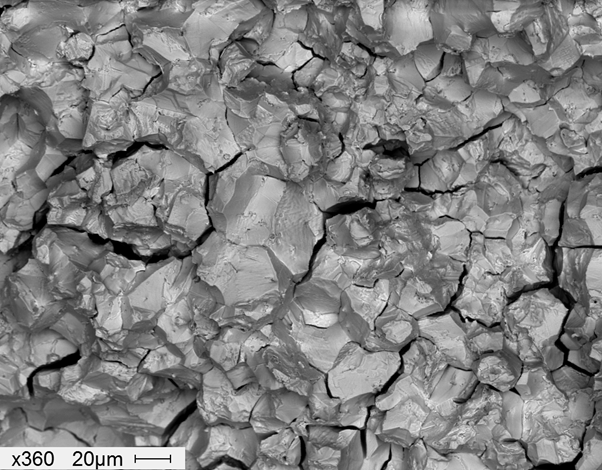
SEM image of the surface of a fractured bolt showing an intergranular fracture mode; this particular sample failed by SCC.
SSCC, being surface induced, will generally develop cracks at the surface and may be identified using surface non destructive testing techniques such as magnetic particle or dye penetrant inspection.
Analysis of components suspected of failure by SSCC would typically require examinations by scanning electron microscopy (SEM) and metallurgical examination by optical microscopy. SEM has the advantage of typically being combined with an energy dispersive X-ray analysis (EDX) facility that allows for elemental analysis of areas of interest. Deposits at the surface of the component and within the cracks can be analysed for the presence of sulphur, that may be a remnant of H2S in the environment, although SEM-EDX is unable to analyse for hydrogen. SEM, and optical microscopy will also identify the mode of crack propagation e.g. intergranular, cleavage, or ductile coalescence, and aids the investigator in the identification or confirmation of SSCC as a failure mechanism.
Avoiding Sulphide Stress Cracking
The primary methods of avoiding SSCC are the selection of resistant alloys, isolation of the material from the environment that contains the hydrogen, or H2S, and reduction of hardness and residual stress.
Materials selection for a particular application will usually be based on strength, such as in fasteners or structural components, and in certain applications, corrosion resistance. A balance then needs to be struck between these parameters to provide sufficient mechanical and corrosion resistant properties. Furthermore, different materials will require different parameters, such as a maximum hardness requirement of 22HRC for low and medium carbon steels, and specific requirements for different materials can be found in NACE MR0175 and ISO15156.
To isolate the material from the environment, the use of coatings, plating, and overlays of weld metal are common practices and these too, to a certain extent are governed by the above standards.
In addition to overlays, welding is clearly a common form of joining metals used in environments that contain H2S, such as in the oil and gas industry. Welds will inherently exhibit high residual stresses and post-weld heat treatments may typically be required to reduce residual stress and lower the hardness developed in heat affected zones, and so strict controls on the welding and subsequent treatments are critical in the avoidance of SSCC.